
A routine liver panel can look normal even when fat buildup or scar tissue is beginning to affect the liver. That is why noninvasive liver testing advances matter for patients with fatty liver disease, obesity, diabetes, high cholesterol, or a history of elevated liver enzymes. Today, physicians can often assess liver fat and fibrosis without immediately relying on a liver biopsy.
These tools do not replace a thoughtful medical evaluation. They add valuable information that helps your gastroenterologist determine your risk, decide whether more testing is needed, and build a plan that addresses the connected factors behind liver disease – including weight, metabolism, nutrition, medications, and alcohol use.
Why liver scarring needs early attention
The liver can tolerate injury for a long time without causing obvious symptoms. In metabolic dysfunction-associated steatotic liver disease, often called MASLD and previously known as fatty liver disease, excess fat can accumulate in liver cells. For some people, that fat remains relatively stable. For others, it can lead to inflammation and fibrosis, the gradual formation of scar tissue.
Fibrosis is the finding physicians watch most closely because advanced scarring can progress to cirrhosis, portal hypertension, liver failure, or liver cancer. The good news is that identifying fibrosis before it becomes advanced creates an opportunity to act. Weight loss when appropriate, improved blood sugar control, treatment of metabolic risk factors, alcohol reduction or avoidance, and regular follow-up can make a meaningful difference.
A standard blood test that measures ALT or AST is useful, but it does not tell the full story. Enzyme levels can fluctuate, and some people with significant fibrosis have normal values. Noninvasive testing gives clinicians a more complete view of what may be happening beneath those numbers.
Noninvasive liver testing advances improve risk assessment
Modern liver assessment generally uses a step-by-step approach. Instead of ordering every test for every patient, a physician considers your medical history, symptoms, examination, medications, alcohol intake, family history, and metabolic health. Initial blood work may then be paired with specialized scoring tools or imaging.
Blood-based fibrosis scores
Some fibrosis assessments use information already available from routine blood tests. A commonly used calculation, FIB-4, combines age, liver enzymes, and platelet count to estimate the likelihood of advanced fibrosis. It is inexpensive, widely available, and helpful for sorting patients into lower- and higher-risk groups.
FIB-4 is a screening and triage tool, not a final diagnosis. Age can influence the score, and results may be less reliable in certain circumstances, including acute illness or active liver inflammation. When a score is elevated or indeterminate, your physician may recommend a more specific blood test or imaging-based assessment.
Enhanced blood tests can also measure markers associated with fibrosis. These tests may help clarify risk when routine calculations do not provide a clear answer. The right test depends on your clinical situation, insurance coverage, and whether your physician needs information about fat, inflammation, fibrosis, or several of these concerns together.
Elastography measures liver stiffness
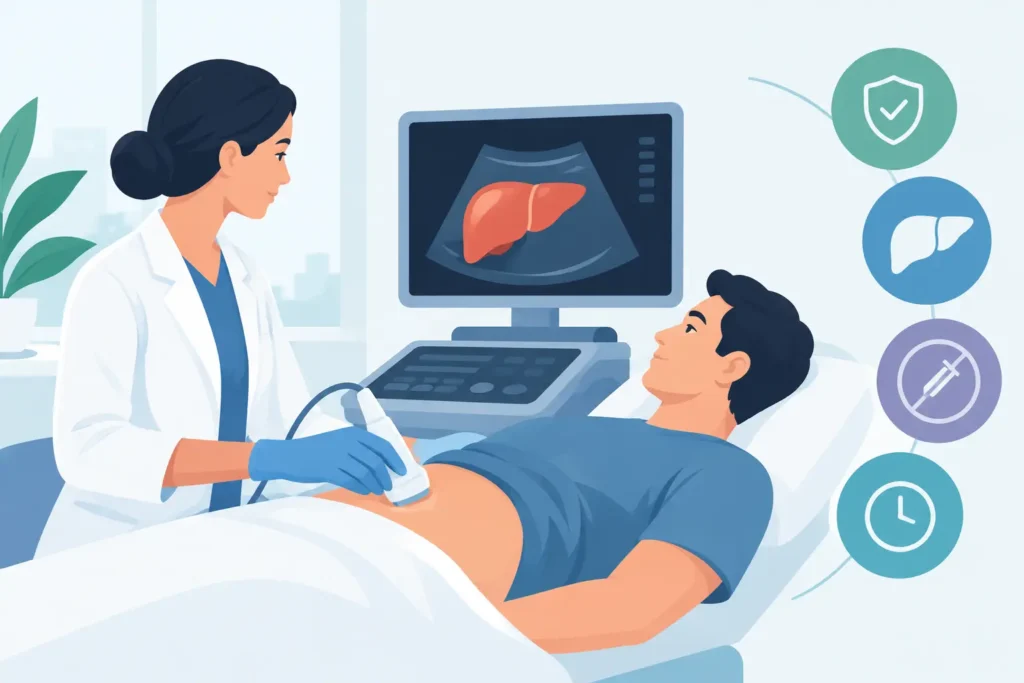
Transient elastography, often known by the brand name FibroScan, is one of the most important advances in noninvasive liver care. The test uses a painless probe placed against the skin over the liver. It sends a gentle vibration through the tissue and measures how quickly the wave travels. Stiffer tissue may indicate more fibrosis.
The appointment is typically brief, requires no needles, and does not involve radiation. Many patients are asked to fast for several hours beforehand because food intake can affect the reading. Results are interpreted alongside blood work and the rest of the clinical picture, rather than in isolation.
Some elastography systems can also estimate the degree of liver fat. This can be useful for monitoring patients with MASLD, particularly when they are working on medically supervised weight loss, improving diabetes control, or making nutrition changes.
Ultrasound-based shear wave elastography is another option. It can be performed during an abdominal ultrasound and may be especially useful when a patient also needs imaging to evaluate the gallbladder, bile ducts, or other abdominal concerns.
MRI-based testing offers added detail in selected cases
MRI elastography can provide highly detailed information about liver stiffness and is often considered when ultrasound-based testing is technically limited or results do not match the rest of the evaluation. MRI-based techniques can also measure liver fat more precisely.
This level of imaging is not necessary for everyone. It can be more expensive, may not be readily available, and may be difficult for patients with claustrophobia or certain implanted medical devices. Still, for selected patients, it can help resolve uncertainty without a biopsy.
What these tests can and cannot tell you
Noninvasive tests have changed how physicians identify and monitor liver fibrosis, but they are not perfect. Liver stiffness can rise temporarily because of inflammation, congestion from heart conditions, bile duct obstruction, or recent food intake. Body size and technical factors can also affect some ultrasound-based measurements.
That is why a single test result should never be treated as a diagnosis by itself. A board-certified gastroenterologist looks for patterns. Does the fibrosis score agree with elastography? Are liver enzymes persistently elevated? Does imaging show signs of chronic liver disease? Are diabetes, high blood pressure, sleep apnea, or elevated triglycerides contributing to risk?
For many patients, the most useful outcome is reassurance: testing shows a low likelihood of advanced fibrosis, allowing for regular monitoring and focused lifestyle treatment. For others, an elevated result signals the need for closer surveillance, additional imaging, medication review, or referral for advanced liver care.
When a liver biopsy may still be appropriate
A liver biopsy remains valuable in certain situations. It may be recommended when noninvasive test results conflict, when the cause of liver disease is unclear, or when a physician needs to distinguish among conditions that can look similar on blood work and imaging. Biopsy may also help assess inflammation or confirm a diagnosis before making major treatment decisions.
Unlike blood testing and elastography, biopsy involves removing a small sample of liver tissue with a needle. It provides direct information, but it also has drawbacks: discomfort, a small risk of bleeding, sampling limitations, and recovery time. The goal of newer testing is not to eliminate biopsy in every case. It is to reserve it for situations where the result is likely to change care.
A connected approach to fatty liver and metabolic health
Fatty liver disease rarely exists on its own. It often travels with insulin resistance, prediabetes or diabetes, obesity, elevated cholesterol, high blood pressure, and sleep apnea. Treating only the liver test result misses the larger opportunity to improve long-term health.
A personalized care plan may include nutrition guidance, physical activity recommendations, management of diabetes or cholesterol, review of medications, and physician-supervised weight treatment when appropriate. Some patients may be candidates for FDA-approved GLP-1-based medications such as semaglutide or tirzepatide as part of a broader obesity medicine plan. These medications are not right for everyone, and they should be selected and monitored by a qualified physician who understands your medical history and digestive health.
Meaningful weight loss can reduce liver fat and may improve inflammation and fibrosis risk. The amount needed varies from person to person. Progress is not measured by the scale alone. Changes in liver tests, metabolic markers, symptoms, body composition, and noninvasive liver measurements can all help guide treatment.
When to ask about noninvasive liver testing advances
Consider speaking with a gastroenterologist if you have persistent abnormal liver enzymes, fatty liver noted on an ultrasound or CT scan, type 2 diabetes, obesity, metabolic syndrome, a family history of liver disease, or regular alcohol use. Testing may also be appropriate if you have been told you have fatty liver but have not had a fibrosis risk assessment.
At NJ Gastroenterology & Health Wellness, liver evaluation can be coordinated with digestive and metabolic care, so your plan addresses both the test results and the factors that may be driving them. A timely consultation can replace uncertainty with a clear next step – whether that means reassurance, monitoring, further evaluation, or a physician-guided plan to protect your liver health over time.